English
Views: 39 Author: Site Editor Publish Time: 2021-12-23 Origin: Site
Each jewelry is injected with the designer and the manufacturer into the soul, and their birth needs very compatible process steps.

Sketching
All jewelry begins with an idea. Design refers to how it looks, as well as the process of planning and refining. To see if the concept looks as good to the eye as it does in the mind, the design is rendered in a series of drawings. It’s important to sketch the piece from multiple angles to make sure it looks as good from the side as it does from the top, and to see if it’s as pretty on the hand as it is against a plain background. Sketches determine what cuts, clasps and mounts look good, if there should be one tier or three, and how many stones and other flourishes should be in the piece.
Sketches serve as a record of the creative process and a time line of trends and styles. Even if a design is used for a brief period, holding on to the drawing serves a purpose for the artist. To serve as a reference later on, drawings are kept in files and uploaded into computer databases.
3D Printing
Three dimensional printing is the mechanized process of creating an object through adding thin layers of material one on top another. 3D printing may be applied to a large range of industries, including jewelry. For designers, the possibilities are vast, allowing complex pieces such as invisible set rings or pendants with surrealist geometry to be made in hours, when making them by hand may take days.
Printed objects may be made from a variety of materials, including plastic, nylon, glass and metals. Depending on the design and application, the printed item may be jewelry in its own right, or used as a step in the manufacturing process. A polymer ring may be used as a master to create rubber molds, or a wax bracelet may be used in lost wax casting. Designers are still exploring the possibilities with this technology.
Lost wax casting
Also known as “investment casting,” lost wax casting is a method of creating a mold often used in jewelry manufacturing. To create a large number of precious metal components in a short amount of time, jewelers will create a large mold from which dozens of findings and other parts are cast at once. The practice is an ancient one, dating at least as far back as the Bronze Age, and used on multiple continents by a number of civilizations.
In jewelry making, lost wax casting usually begins with a rubber mold, which is used to create a number of findings made of wax. The pieces are affixed to a central base and immersed in a plaster known as investment. Investment should fill up every empty space, so there is no air bubbles between it and the wax tree. The trunk of the tree shouldn’t be covered in plaster, but have its tip visible from the top of the cylinder. Once the investment dries, the cylinder is placed into a kiln that melts the wax away, leaving a negative space inside the plaster in which to cast metal jewelry.
Polishing
One of the finishing touches to ready a piece of jewelry for display is polishing. The act removes any remaining rough surfaces and edges, and helps the piece to shine. Though the same term is used for both metal and gemstones, the approaches are different. For precious metal, polishing doesn’t always involve a mirror like shine, but may leave a more matte appearance, like the brush finish. What unites metal polishing is the use of polishing wheels, leather strops, and use of the abrasives jeweler’s rouge, pumice and tripoli. Depending on the metal and design, polishing may also remove unwanted oxidation from the piece.
In gemstones, polish is used to enhance a jewel’s luster. As gems vary greatly in terms of hardness and durability, there is no one size fits all approach. Gemstones also have differing ways of reflecting light. Abrasives and tools are adjusted accordingly to help bring out the best in a stone without accidental damage.
Laser engraving
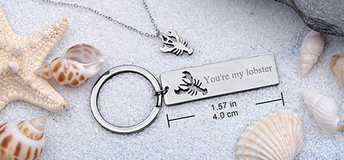
A modern addition to the engraving process, lasers are being used to imprint designs and information onto jewelry and stones. Traditional engraving tools include burins, which are manually operated and require a steady hand. Rather than have a tool come into direct contact with the jewelry, lasers use concentrated light and heat to carve patterns into gemstones. The wavelengths of the laser can be adjusted to burn different alloys and stones of varying chemical compositions. Care must be taken to avoid accidentally chipping a stone’s surface.
Lasers can be used on surfaces both flat and curved. They also have the advantage of precision, to engrave exactly what needs to be done without missing or carving at the wrong depth. They also have the ability to mark areas both large and tiny. The Gemological Institute of America uses lasers to imprint the institution’s name and a stone’s number on the diamonds they grade, allowing others to easily verify a diamond’s provenance. These numbers are engraved on the stone’s girdle, to small for a person to casually find.